
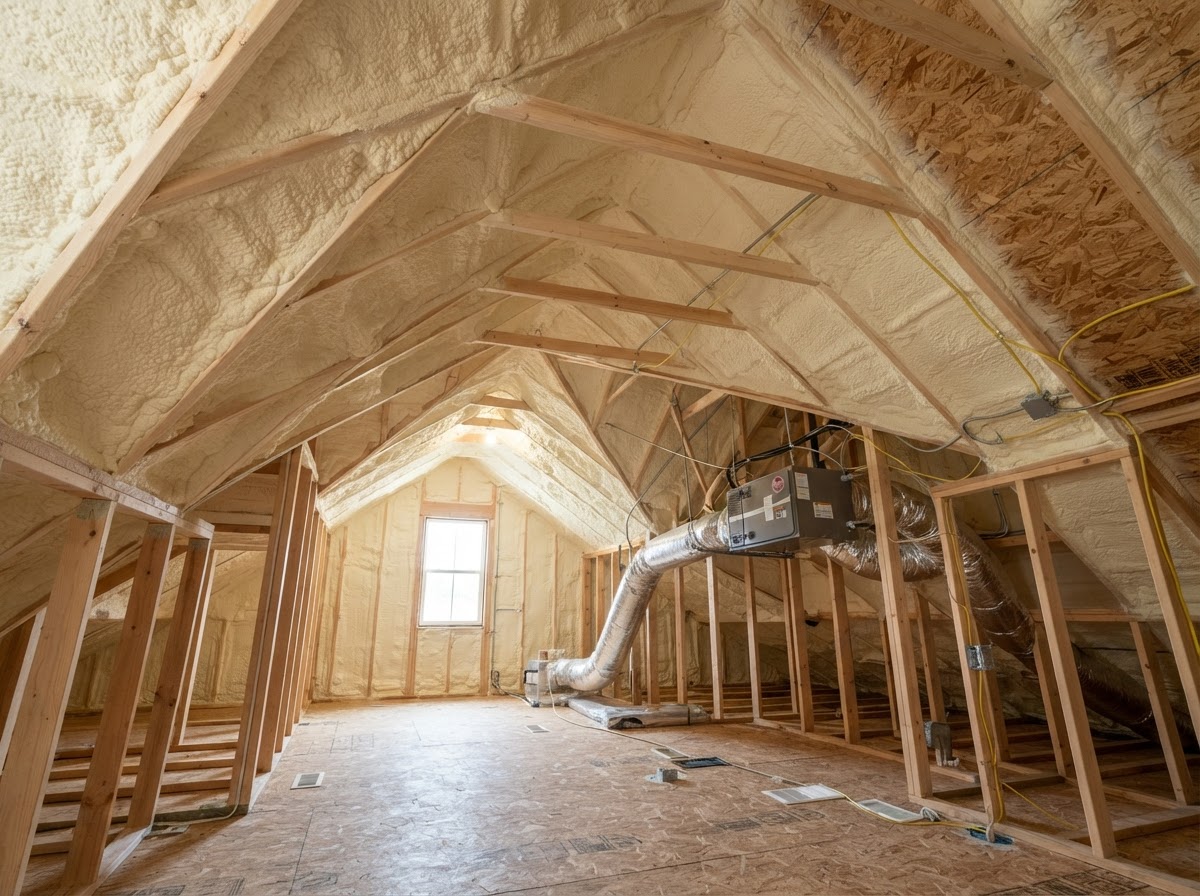
Attic Spray Foam Insulation in San Marcos, TX
Roofline & Attic Floor Foam for Existing Homes, New Construction & HVAC Protection
Attic spray foam insulation in San Marcos, TX brings the performance of polyurethane foam to one of the most impactful areas of a home or building. San Marcos Spray Foam Installation installs open-cell and closed-cell foam in residential attics, at the roof deck, and along roof rafters throughout the San Marcos area and surrounding Central Texas communities. The right strategy—attic floor versus roofline—depends on the building design, ventilation, HVAC equipment location, and whether the attic is vented or being converted to unvented. Request an attic spray foam estimate to discuss your home.
Attic Spray Foam Solutions Near San Marcos, TX
The attic is often the most impactful area to insulate because it is where the building meets the hottest surface—the sun-baked roof. In hot Central Texas summers, attic air temperatures can far exceed outdoor air temperature, and that heat radiates into living space below. Attic spray foam addresses this by establishing a continuous, air-sealing layer at the roofline or attic floor, depending on the chosen strategy.
Two primary strategies shape attic foam projects. An attic floor application insulates the ceiling below while leaving the attic vented; a roof deck or roofline application moves the thermal boundary to the underside of the roof, bringing the attic inside the conditioned envelope. Each strategy has implications for ventilation, HVAC equipment, and building design, and the choice depends on the specific home.
Attic foam serves existing homes and new construction alike. Existing homes often retrofit the roofline to bring a hot attic inside the envelope and protect HVAC equipment; new construction can plan the attic strategy before finishes. Existing insulation, ventilation, and moisture conditions are evaluated before any work begins, and the strategy is planned around the home's assembly and HVAC design.
Roof Deck & Roofline
Foam at the underside of roof rafters to bring the attic inside the envelope.
Attic Floor
Ceiling-level insulation for vented attic strategies where appropriate.
HVAC & Duct Protection
Bringing mechanical equipment and ductwork inside the conditioned envelope.
Attic Strategy: Roofline vs. Floor & Ventilation Considerations
Should spray foam go on the attic floor or the roof deck?
It depends on the building design, ventilation strategy, and HVAC equipment location. A roof deck application moves the thermal boundary to the roofline, bringing the attic inside the conditioned envelope; an attic floor application insulates the ceiling below while leaving the attic vented. We evaluate the home's assembly, ventilation, and mechanical systems before recommending a strategy.
Roof deck and roofline applications move the thermal boundary to the roof. Foam at the underside of the roof rafters brings the attic inside the conditioned or semi-conditioned envelope, which protects HVAC equipment and ductwork located in the attic and can support more consistent interior temperatures. This is a common retrofit and new-construction strategy, and it changes the attic's ventilation.
Attic floor applications keep the attic vented and insulate the ceiling below. This strategy works when the attic is vented and HVAC equipment is not located in the attic. The choice between floor and roofline depends on the home's design, mechanical systems, and ventilation strategy—and should not be made without considering combustion safety for gas equipment and the building's ventilation design.
Ventilation and HVAC considerations are central. Sealing an attic changes how the building handles air and humidity, which can affect HVAC performance and combustion safety. We do not recommend sealing attic ventilation without proper assembly planning. Existing insulation, the home's ventilation design, and moisture conditions are evaluated before any attic project, and the strategy is planned around the home's specific assembly.
Roofline Envelope
Moving the thermal boundary to the roof deck to condition the attic.
Vented Floor Strategy
Ceiling insulation for homes where a vented attic is the right approach.
Ventilation & HVAC
Assembly, ventilation, and mechanical systems evaluated before installation.
Attic Spray Foam Installation Process
Attic projects begin with evaluating the existing attic, insulation, ventilation, and HVAC. We follow a structured process adapted to attic assemblies, with jobsite preparation, ventilation, and product-specific procedures throughout.
Jobsite preparation, ventilation, protective equipment, curing conditions, and re-entry procedures should follow the specific product requirements and project plan.
- 01
Attic Consultation
We review your comfort concerns, attic access, and HVAC equipment location to scope the project.
- 02
Strategy & Ventilation Review
We evaluate roofline vs. floor strategy, existing insulation, ventilation, and moisture conditions.
- 03
Preparation & Removal
Existing insulation is removed as needed; surfaces and mechanical components are protected.
- 04
Attic Application
Foam is applied to the roof deck, roofline, or attic floor per the chosen strategy.
- 05
Coverage & Thickness Review
Applied depth and coverage are verified across rafters or the attic floor.
- 06
Cleanup & Re-Entry Guidance
We clean the attic and provide ventilation and re-entry guidance specific to the product used.
Attic Insulation Across San Marcos & Central Texas
San Marcos Spray Foam Installation insulates attics for homeowners across San Marcos, Hays County, and the surrounding Central Texas communities. Hot Central Texas summers make attic insulation one of the most common retrofit and new-construction priorities in the region, and the I-35 corridor's mix of existing homes and new construction means we see a range of attic assemblies.
Whether your home needs a roofline retrofit, an attic floor application, or a new-construction attic strategy, the right approach depends on the building design, ventilation, HVAC equipment, and existing conditions. We help homeowners understand the tradeoffs and plan the right scope.
Related attic and residential services:
Attic Spray Foam for Your San Marcos Home?
Talk with San Marcos Spray Foam Installation about your attic's roofline, ventilation, and HVAC. We help you choose the right strategy and plan the right scope for your home.
Attic Spray Foam FAQs for San Marcos Homeowners
Can spray foam be installed in an attic?
Yes. Attic spray foam is one of the most common and impactful applications. It can be installed at the roof deck or roofline to bring the attic inside the conditioned envelope, or at the attic floor depending on the strategy. Existing insulation and ventilation are evaluated before installation.
Should spray foam go on the attic floor or the roof deck?
It depends on the building design, ventilation strategy, and HVAC equipment location. A roof deck application moves the thermal boundary to the roofline and conditions the attic; an attic floor application insulates the ceiling below while leaving the attic vented. We evaluate the home's assembly and mechanical systems before recommending a strategy.
Can spray foam create an unvented attic?
Yes, when the assembly is appropriate. Applying foam to the underside of the roof deck can create an unvented, conditioned or semi-conditioned attic. This changes the attic's ventilation and should be planned with the building's design, moisture strategy, and HVAC in mind. See our roof deck & unvented attic page for details.
Open cell or closed cell for an attic?
Both are used in attics. Open-cell foam is common at the roofline for its high expansion and air sealing; closed-cell foam may be considered where density or vapor characteristics are relevant. The choice depends on the assembly, moisture strategy, and project goals. We recommend a type based on your attic.
Does existing attic insulation need evaluation before spraying?
Yes. Existing insulation is evaluated before any attic project. Old, degraded, or contaminated insulation may need removal before spraying, while insulation in good condition may not. The existing ventilation and moisture conditions are also evaluated as part of the strategy.
How much does attic spray foam cost?
Cost depends on the attic size, chosen strategy (roofline vs. floor), foam type, installed thickness, existing insulation removal, accessibility, and overall project scope. Request a project-specific estimate for accurate attic pricing.
Attic Spray Foam for Your San Marcos Home?
Talk with San Marcos Spray Foam Installation about your attic's roofline, ventilation, and HVAC. We help you choose the right strategy and plan the right scope for your home.