
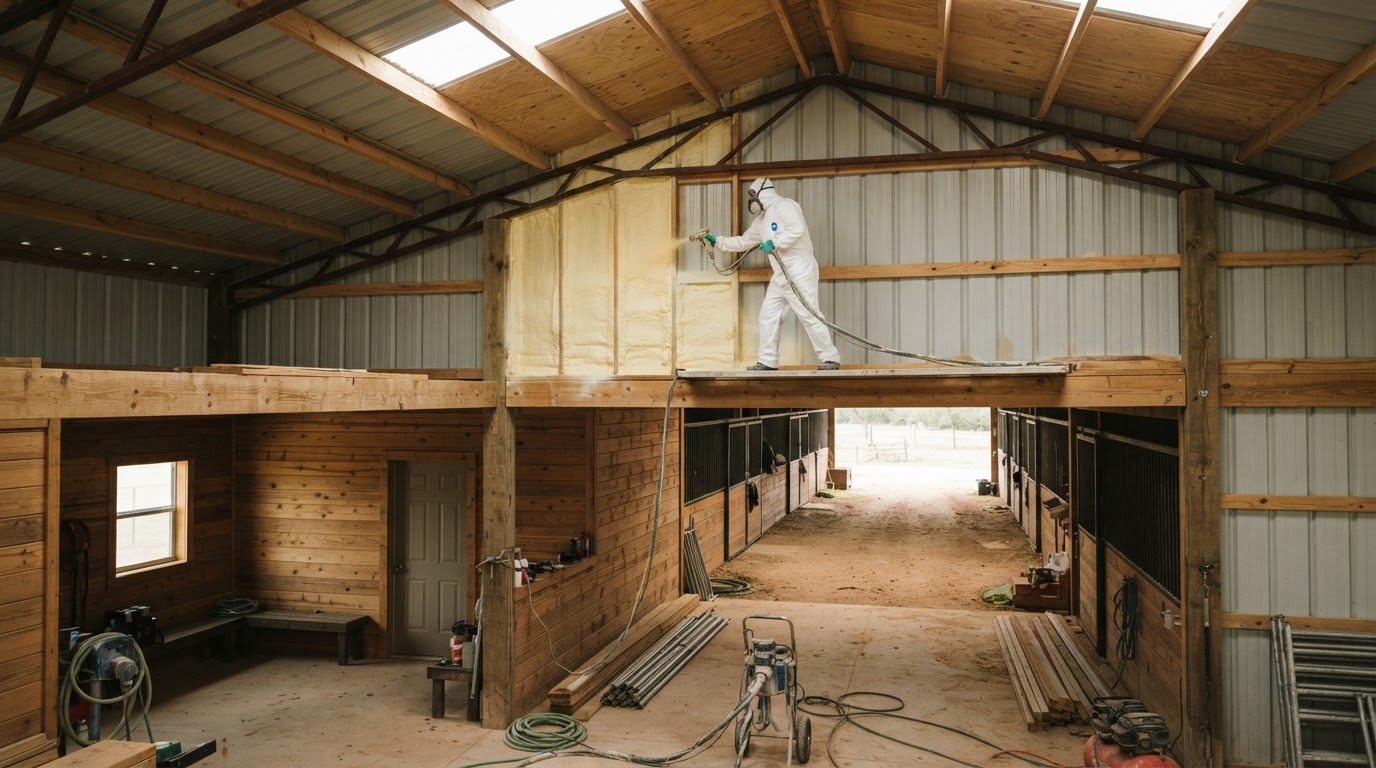
Horse Barn & Livestock Building Spray Foam Insulation in San Marcos, TX
Ventilation-aware spray foam for tack rooms, feed rooms, conditioned utility areas, and suitable barn roof and wall assemblies
Horse barn and livestock building spray foam insulation in San Marcos, TX must account for the ventilation, humidity, and air-quality needs of animal housing. San Marcos Spray Foam Installation considers spray foam for suitable building-envelope surfaces in horse barns and livestock buildings across San Marcos and surrounding Central Texas communities, including tack rooms, feed rooms, and conditioned utility areas. Spray foam does not replace proper ventilation, and any insulation plan must be integrated with the structure's moisture and air-quality strategy. Request an estimate to discuss your horse barn or livestock building project.
Spray Foam in Horse Barns & Livestock Buildings Near San Marcos
Horse barns and livestock buildings in the San Marcos area combine several space types: stalls and aisle areas, tack rooms, feed rooms, attached workshops, and conditioned utility areas. Each has different insulation and ventilation requirements. Animal housing requires careful attention to ventilation, humidity, interior moisture, and air quality, and spray foam is not a substitute for that ventilation.
Spray foam may be considered for suitable building-envelope surfaces, such as tack room walls, feed room areas, conditioned utility spaces, and selected barn roof or wall assemblies that are separated from direct animal-occupied zones. In these areas, foam can help reduce uncontrolled air leakage and manage interior surface temperatures.
Exposed foam in animal-occupied areas requires protection considerations, and assembly design must account for how the building is used. Not every barn surface is appropriate for spray foam, and livestock occupancy introduces additional moisture and ventilation considerations that must be part of the planning.
Tack & Feed Rooms
Conditioned or semi-conditioned tack and feed rooms can use spray foam to reduce air leakage and manage interior temperatures.
Conditioned Utility Areas
Attached workshops and utility spaces separated from animal zones may be suitable for spray foam envelope insulation.
Ventilation-Aware Planning
Animal housing requires ventilation and moisture planning integrated with any insulation; foam does not replace ventilation.
Open Cell vs. Closed Cell for San Marcos Horse Barns
Does spray foam replace ventilation in a horse barn?
No. Spray foam does not replace proper ventilation in a horse barn or livestock building. Animal housing requires careful attention to ventilation, humidity, interior moisture, and air quality. Spray foam may be considered for suitable building-envelope surfaces, such as tack rooms, feed rooms, and conditioned utility areas, when integrated with the structure's ventilation and moisture strategy.
Closed-cell spray foam cures rigid and generally offers higher thermal resistance per inch than open-cell products, though exact R-value varies by product, manufacturer, formulation, and installed thickness. Its lower vapor permeance can be relevant for certain barn assemblies where moisture is a concern. Closed-cell foam does not make a barn waterproof, and moisture control depends on the whole building, ventilation, and humidity sources.
Open-cell spray foam is lower density and expands significantly, which can help fill irregular framed cavities in suitable barn areas. Because it is more vapor permeable, it is not the right choice for every surface or moisture condition, especially in animal-occupied zones.
Exposed foam protection is a consideration in barns. Assembly design must account for animal contact, cleaning, and building use. Spray foam can help reduce uncontrolled air movement when correctly selected and installed as part of an appropriate, ventilation-aware building-envelope strategy.
Ventilation First
Animal housing ventilation and air quality must be part of any insulation plan; spray foam does not replace ventilation.
Moisture Awareness
Livestock occupancy introduces humidity and moisture that must be managed through the whole building, not foam alone.
Exposed Foam Protection
Where foam is used, assembly design must account for animal contact, cleaning, and protection of exposed surfaces.
How Horse Barn Spray Foam Is Planned Near San Marcos
A professional horse barn or livestock building insulation project follows a high-level sequence focused on ventilation, moisture, and building use. Spray polyurethane foam application requires appropriate protective equipment, ventilation, equipment, and manufacturer procedures.
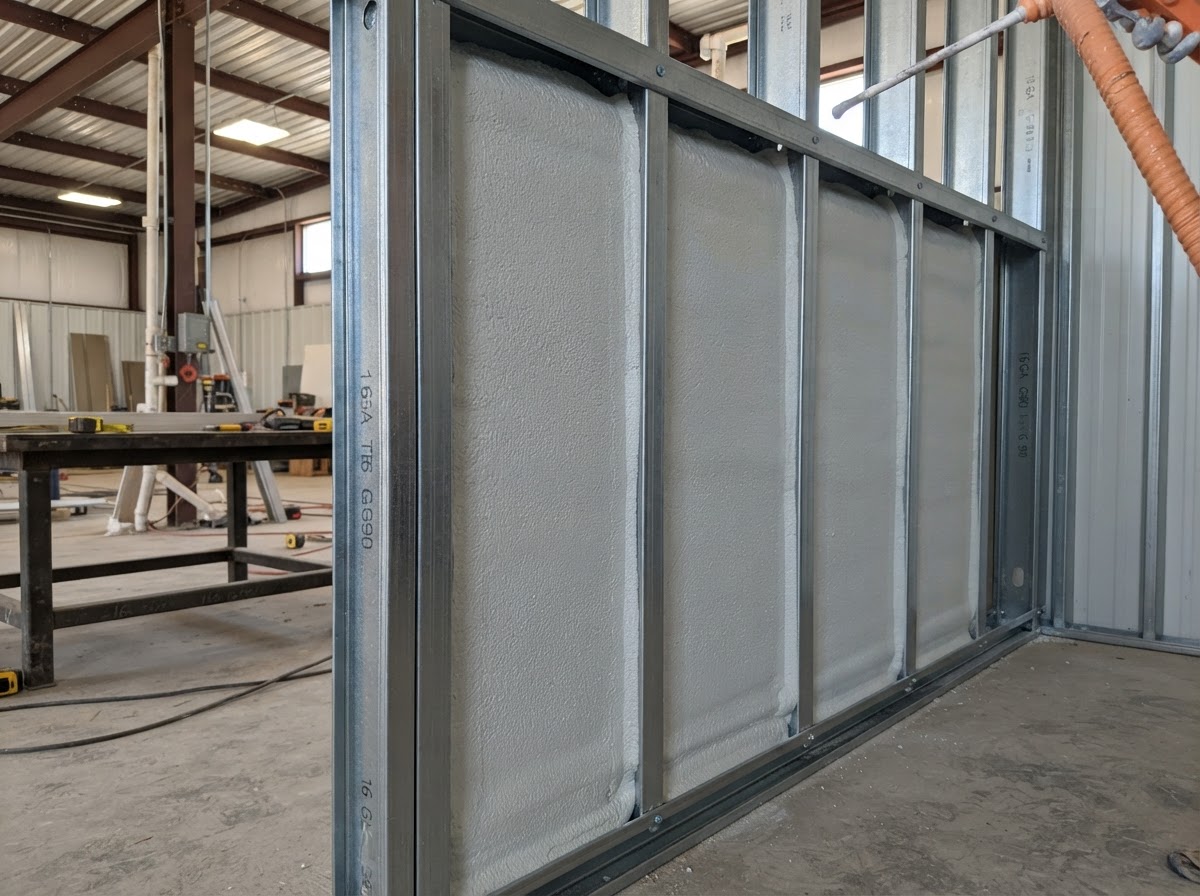
Jobsite preparation, ventilation, protective equipment, curing conditions, and re-entry procedures should follow the specific product requirements and project plan.
- 1
Project Discussion
We review how the barn is used, which areas house animals, and which areas are tack, feed, or utility spaces.
- 2
Ventilation & Moisture Review
We discuss the barn's ventilation, humidity, and air-quality needs and how insulation fits that strategy.
- 3
Surface & Assembly Planning
We identify suitable envelope surfaces and discuss open-cell or closed-cell foam and exposed-foam protection.
- 4
Work-Area Preparation
Animal-occupied areas are considered, adjacent spaces are protected, and the area is prepared for application.
- 5
Professional Application
Spray foam is professionally applied to planned surfaces following product-specific procedures and conditions.
- 6
Coverage Review & Guidance
Coverage and thickness are reviewed, the area is cleaned, and project-specific ventilation and re-entry guidance is provided.
Horse Barn Insulation in the San Marcos Area
Horse barns and livestock buildings are common across San Marcos and the surrounding Central Texas region, from ranch properties in Hays County to acreage in the Texas Hill Country. Hot, humid conditions make ventilation and moisture management essential in any animal-housing insulation plan.
San Marcos Spray Foam Installation considers spray foam for suitable horse barn and livestock building surfaces in the San Marcos, Texas area. Related options include our pole barn spray foam, agricultural building spray foam, metal building spray foam, closed-cell spray foam, and general spray foam services.
Planning a Horse Barn or Livestock Building Project in San Marcos, TX?
Talk with San Marcos Spray Foam Installation about your horse barn or livestock building. We will help you understand which surfaces may be suitable and how ventilation and moisture fit the plan.
Horse Barn & Livestock Building Spray Foam FAQs for San Marcos Property Owners
Does spray foam replace ventilation in a horse barn?
No. Spray foam does not replace proper ventilation in a horse barn or livestock building. Animal housing requires careful attention to ventilation, humidity, interior moisture, and air quality. Spray foam may be considered for suitable building-envelope surfaces when integrated with the structure's ventilation and moisture strategy.
Can spray foam be used in a horse barn?
Spray foam may be considered for suitable surfaces such as tack rooms, feed rooms, and conditioned utility areas separated from direct animal-occupied zones. Exposed foam in animal areas requires protection considerations, and not every barn surface is appropriate. An on-site evaluation helps determine what is feasible.
What about humidity and moisture from animals?
Livestock occupancy introduces humidity and moisture that must be managed through the whole building, including ventilation and the building envelope. Spray foam does not eliminate moisture on its own, and any insulation plan must be integrated with the structure's moisture and air-quality strategy.
Open cell or closed cell for a horse barn?
Closed-cell foam may be considered for certain barn assemblies where lower vapor permeance is relevant, while open-cell foam may suit certain interior framed areas. Selection depends on the surface, use, and moisture conditions, and exposed-foam protection must be part of the plan.
Can tack and feed rooms be insulated?
Yes, conditioned or semi-conditioned tack and feed rooms can often use spray foam to reduce air leakage and manage interior temperatures. These spaces are typically separated from direct animal-occupied zones, which makes them more suitable for envelope insulation.
How is a horse barn spray foam project priced?
Pricing depends on the total surface area, foam type, installed thickness, access, substrate preparation, exposed-foam protection, and overall project scope. Because every barn is different, we provide project-specific estimates. Call 512-967-8730 to discuss your horse barn.
Planning a Horse Barn or Livestock Building Project in San Marcos, TX?
Talk with San Marcos Spray Foam Installation about your horse barn or livestock building. We will help you understand which surfaces may be suitable and how ventilation and moisture fit the plan.