
Existing Home & Retrofit Spray Foam Insulation in San Marcos, TX
Targeted Foam Upgrades for Older Homes, Attics, Remodels & Additions
Existing home & retrofit spray foam insulation in San Marcos, TX brings the performance of polyurethane foam to properties already standing, applying foam to accessible attics, roof decks, open wall cavities during remodels, garages, and additions. San Marcos Spray Foam Installation installs open-cell and closed-cell foam for older homes and renovation projects throughout the San Marcos area and surrounding Central Texas communities. Retrofit projects require evaluation of existing insulation, moisture conditions, access, and ventilation—foam cannot simply be sprayed into every closed wall. Request a retrofit spray foam estimate to discuss your home's access and goals.
Retrofit Spray Foam Insulation Near San Marcos for Existing Homes
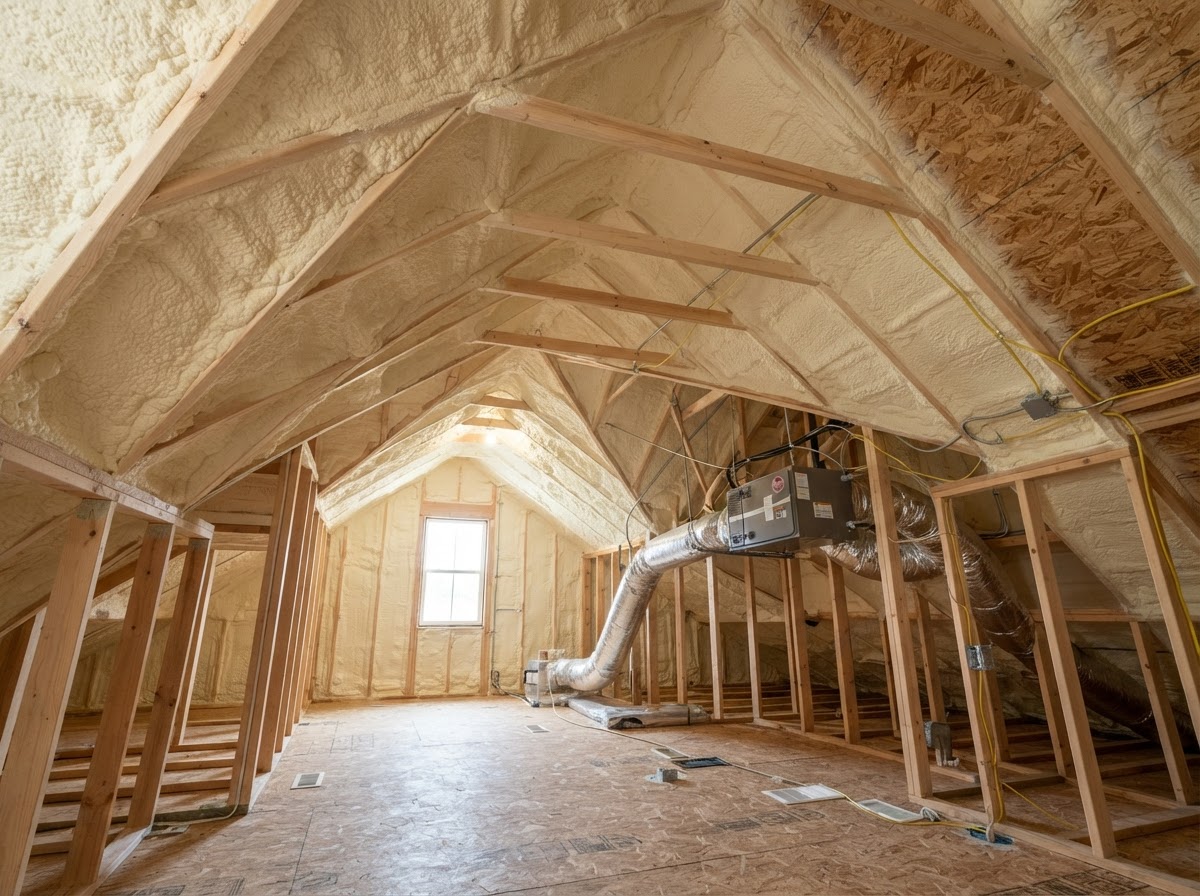
Retrofit spray foam addresses the comfort and performance gaps in homes that were built before modern envelope standards. The most common retrofit is the attic, where foam is applied to the roof deck rafters to bring the attic inside the conditioned envelope. Other retrofit applications include roof decks, open wall cavities during remodeling, garages, and additions where framing is accessible.
Retrofit work differs from new construction because of access. Fully enclosed finished walls generally cannot be spray-foamed without opening them; standard spray foam application requires access to the cavity. During a remodel with drywall removed, wall cavities become accessible and foam becomes a strong option. We evaluate your home's access and existing conditions before recommending an approach.
Property owners search for retrofit spray foam when older homes have hot rooms, persistent drafts, aging insulation, or additions that need proper envelope design. Existing moisture conditions, ventilation, and HVAC considerations all influence the retrofit strategy. The right approach depends on what is accessible and the home's specific assembly.
Attic Retrofits
Foam at the roof deck to bring an existing attic inside the envelope.
Remodel-Phase Walls
Cavity fill when walls are opened during renovation projects.
Garages & Additions
Insulation for converted garages and new additions to existing homes.
Retrofit Evaluation & Building-Envelope Considerations
Can spray foam be added to an existing house?
Yes, when the assembly is accessible. The most common retrofit is the attic roofline; foam can also be installed in wall cavities during remodels and in garages or additions. Fully enclosed finished walls generally require opening before foam can be applied. We evaluate access, existing insulation, and moisture conditions first.
Existing insulation evaluation is a key retrofit step. Old, degraded, or contaminated insulation may need removal before spraying, depending on its condition and the chosen strategy. We inspect existing insulation and advise on whether removal is necessary as part of the project plan.
Existing moisture conditions matter. Older homes may have hidden moisture issues, ventilation changes, or envelope problems that affect foam suitability. A retrofit changes how the assembly handles air and humidity, so moisture conditions and ventilation strategy are evaluated before any work begins.
Building-envelope changes and HVAC considerations go hand in hand with retrofits. Sealing an attic or wall assembly changes the home's air dynamics, which can affect HVAC performance and combustion safety. Project accessibility—what can be reached without demolition—shapes what is feasible. We are transparent about what a retrofit can and cannot achieve for your home.
Existing Insulation Review
Evaluation and removal of old insulation when condition requires it.
Moisture Evaluation
Existing moisture and ventilation conditions assessed before spraying.
Access Planning
Retrofit scope matched to what is accessible without unnecessary demolition.
Retrofit Spray Foam Installation Process
Retrofit projects begin with evaluation of existing conditions and access. We follow a structured process adapted to existing homes, with jobsite preparation, ventilation, and product-specific procedures throughout.
Jobsite preparation, ventilation, protective equipment, curing conditions, and re-entry procedures should follow the specific product requirements and project plan.
- 01
Home Evaluation
We review your comfort concerns, home age, and access to understand the retrofit goals.
- 02
Existing Conditions Review
We inspect existing insulation, moisture conditions, ventilation, and access to plan the retrofit.
- 03
Preparation & Removal
Existing insulation is removed as needed; surfaces and furnishings are protected before spraying.
- 04
Retrofit Application
Foam is applied to accessible assemblies—attic roofline, open walls, garages—per the plan.
- 05
Coverage & Trim
Applied depth is verified; foam is trimmed flush where finishes will follow.
- 06
Cleanup & Re-Entry Guidance
We clean the home and provide ventilation and re-entry guidance specific to the product used.
Retrofit Insulation for San Marcos & Central Texas Existing Homes
San Marcos Spray Foam Installation retrofits existing homes for property owners across San Marcos, Hays County, and the surrounding Central Texas communities. Older homes along the I-35 corridor and in the Texas Hill Country often benefit from attic and remodel-phase foam upgrades, and our recommendations reflect your home's age, access, and existing conditions.
Whether your home needs an attic retrofit, a remodel-phase wall insulation project, or a garage or addition upgrade, the right approach depends on access, existing insulation, moisture conditions, and ventilation. We help homeowners determine what is feasible and plan the retrofit accordingly.
Related retrofit and residential services:
Retrofitting an Existing Home in San Marcos, TX?
Talk with San Marcos Spray Foam Installation about your existing home's attic, remodel, or addition. We help you evaluate access and plan the right retrofit for your property.
Existing Home & Retrofit Spray Foam FAQs for San Marcos Homeowners
Can spray foam be added to an existing house?
Yes, when the assembly is accessible. The most common retrofit is the attic roofline; foam can also be installed in wall cavities during remodels and in garages or additions. Fully enclosed finished walls generally require opening before foam can be applied.
Does old insulation need to be removed before spraying?
It depends on the condition. Old, degraded, or contaminated insulation may need removal before spraying, while insulation in good condition may not. We inspect existing insulation and advise on whether removal is necessary as part of the project plan.
Can spray foam be installed during a remodel?
Yes. A remodel with drywall removed offers access to wall cavities, making spray foam a strong option. This is one of the most effective ways to insulate existing walls, since the cavities are open and accessible during renovation.
Can closed walls be insulated with spray foam?
Fully enclosed finished walls generally cannot simply be spray-foamed without access. Standard spray foam application requires access to the cavity. We evaluate your wall assembly and access before recommending an approach, and we are transparent about feasibility.
Can an existing attic be converted to spray foam?
Yes. Converting an existing attic to spray foam—typically at the roofline—is one of the most common and impactful retrofits. Existing insulation, ventilation, and moisture conditions are evaluated first, and the strategy is planned around your home's assembly.
What determines retrofit spray foam pricing?
Pricing depends on the application area, foam type, installed thickness, existing insulation removal, accessibility, preparation, and overall project scope. Retrofit work may include removal and access considerations that affect cost. Request a project-specific estimate for accurate pricing.
Retrofitting an Existing Home in San Marcos, TX?
Talk with San Marcos Spray Foam Installation about your existing home's attic, remodel, or addition. We help you evaluate access and plan the right retrofit for your property.