
Cathedral & Vaulted Ceiling Spray Foam Insulation in San Marcos, TX
Spray Foam for Sloped Roof Assemblies, Limited Cavity Depth, Roof Decking & Vaulted Roof Applications
Cathedral and vaulted ceiling spray foam insulation in San Marcos, TX addresses the sloped roof assemblies, limited cavity depth, and roofline thermal-boundary questions that define cathedral and vaulted ceilings across the San Marcos area and surrounding Central Texas communities. San Marcos Spray Foam Installation installs open-cell and closed-cell polyurethane foam for cathedral ceiling roof decks and rafters, with attention to ventilation channels, unvented roof assemblies, and moisture strategy. We do not instruct homeowners to simply block ventilation; roof assembly changes require building-specific planning. Request a cathedral ceiling spray foam estimate to discuss your project.
Spray Foam for Cathedral and Vaulted Ceilings Near San Marcos, TX
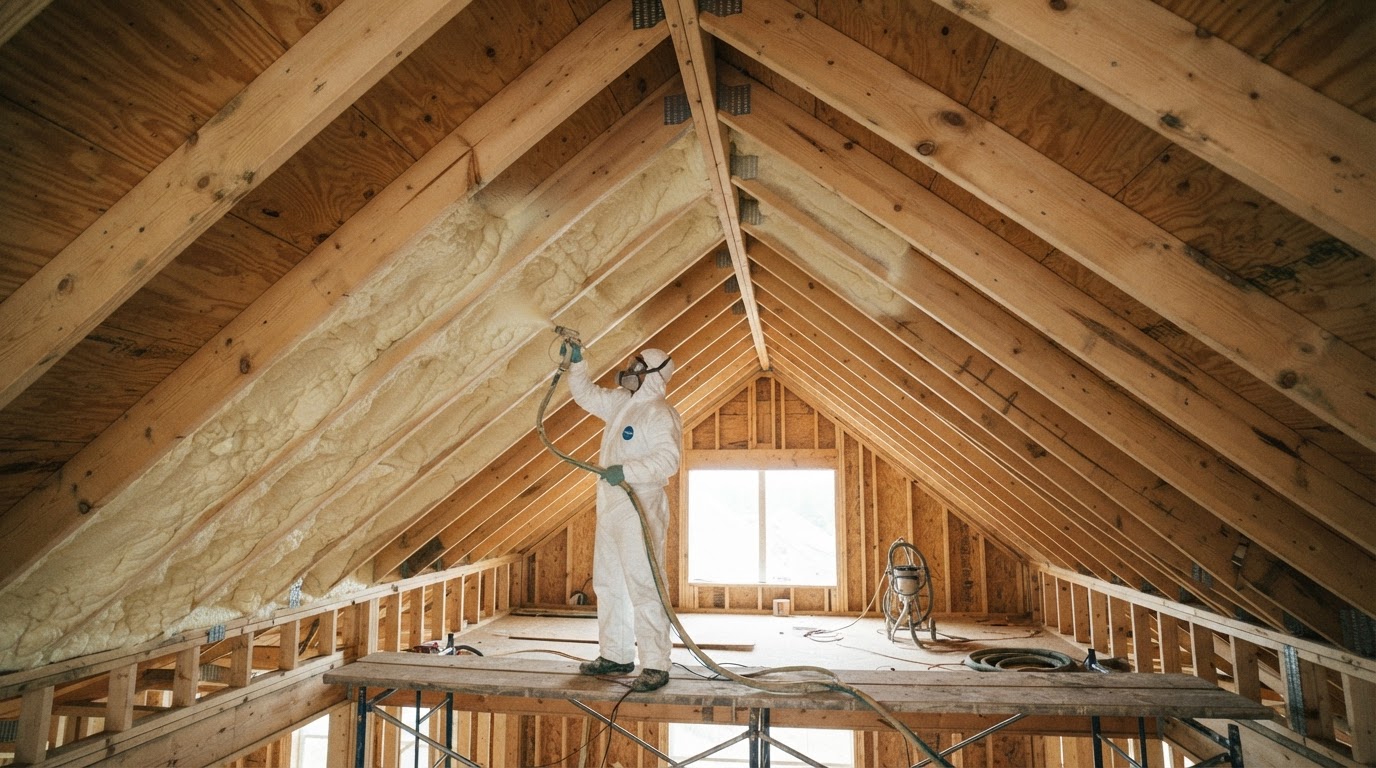
Cathedral and vaulted ceilings in the San Marcos area are sloped roof assemblies: the ceiling follows the roofline, so the insulation must go between the rafters against the roof decking. This is different from a flat attic floor, where insulation sits below a vented attic. Spray foam is applied directly to the underside of the roof decking and between the rafters, expanding to fill the rafter cavities and establish a continuous layer of thermal resistance and air sealing at the roofline.
The defining characteristic of cathedral ceiling insulation is limited cavity depth. The rafter depth constrains how much insulation can be installed, and the roof assembly strategy—vented or unvented—must be planned with the cavity depth, moisture strategy, and roof deck conditions. Closed-cell foam, with its higher thermal resistance per inch in many products, is often considered where rafter depth is limited. Open-cell foam may suit deeper rafter cavities where its higher expansion and vapor permeability are acceptable.
Roof assembly design is central. A vented cathedral ceiling relies on ventilation channels between the insulation and the roof deck; an unvented cathedral ceiling moves the thermal boundary to the roofline without ventilation channels. We do not instruct homeowners to simply block ventilation; the choice between vented and unvented requires building-specific planning around moisture strategy, roof deck conditions, and applicable requirements. New construction and remodeling may point toward different approaches.
Sloped Roof Assemblies
Foam for cathedral and vaulted ceiling roof decks and rafters.
Limited Cavity Depth
Closed-cell foam for shallow rafter cavities.
Roofline Thermal Boundary
Foam that moves the thermal boundary to the roofline where appropriate.
Cathedral Ceiling Performance, Foam Selection & Roof Assembly
Can a vaulted roof assembly be made unvented?
Yes, in many cases a vaulted or cathedral roof assembly can be designed as an unvented assembly, but it requires building-specific planning around moisture strategy, roof deck conditions, cavity depth, and applicable requirements. We do not instruct homeowners to simply block ventilation; the assembly must be planned as a system.
Air sealing at the roofline is a primary benefit. Foam expands to fill rafter cavities and gaps around penetrations, helping establish a continuous thermal boundary at the roofline and reduce uncontrolled air movement through the sloped assembly. A continuous roofline envelope helps the space below hold conditioned air more effectively when mechanical conditioning is present.
Foam selection follows the cavity depth and assembly strategy. Closed-cell foam offers higher thermal resistance per inch in many products, lower vapor permeance, and a rigid cured structure that suits shallow rafter cavities and unvented roof assemblies. Open-cell foam is lower-density and higher-expansion, useful for deeper rafter cavities where its vapor permeability is acceptable in a vented or appropriately planned assembly. Exact R-value per inch varies by product, manufacturer, formulation, and installed thickness.
Moisture strategy is central to cathedral ceiling insulation. A vented cathedral ceiling needs ventilation channels; an unvented cathedral ceiling relies on the assembly design to manage moisture. We do not instruct homeowners to simply block ventilation; the choice requires building-specific planning around roof deck conditions, cavity depth, and applicable requirements. Roof deck conditions are evaluated before recommending an approach.
Roofline Air Sealing
Foam fills rafter cavities to establish a continuous thermal boundary.
Shallow-Cavity Strategy
Closed-cell foam for limited rafter depth.
Assembly-Aware
Vented or unvented strategy planned as a system, not by blocking vents.
Cathedral Ceiling Spray Foam Installation Process Near San Marcos
Cathedral ceiling projects require evaluation of the roof assembly, cavity depth, and moisture strategy. We follow a structured process adapted to sloped roof assemblies, with jobsite preparation, ventilation, and product-specific procedures throughout. We do not provide DIY chemical application instructions.
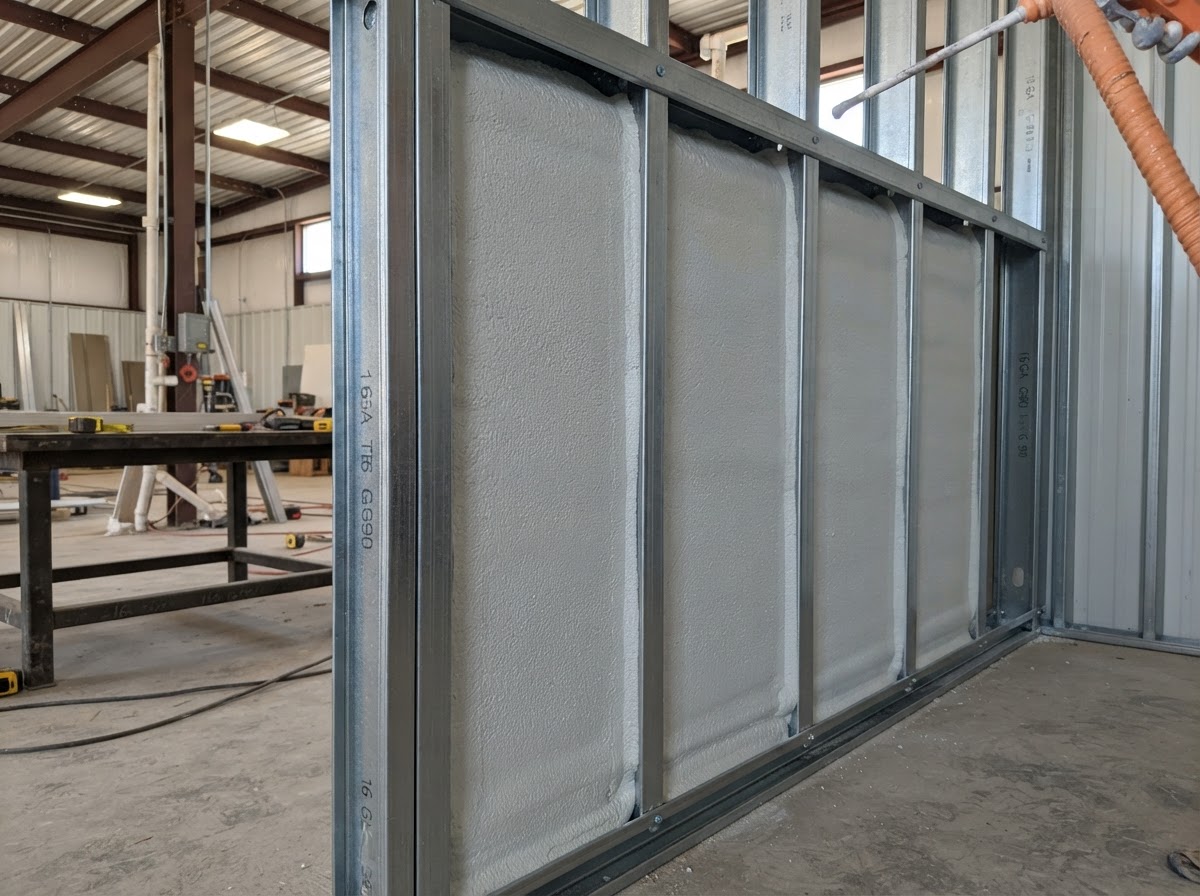
Jobsite preparation, ventilation, protective equipment, curing conditions, and re-entry procedures should follow the specific product requirements and project plan.
- 01
Project Consultation
We review your cathedral or vaulted ceiling, construction, and goals to scope the project.
- 02
Roof Assembly Review
We inspect the rafters, roof deck, cavity depth, and moisture conditions.
- 03
Preparation & Protection
The space below and adjacent surfaces are protected.
- 04
Foam Application
Open-cell or closed-cell foam is applied to the roof deck and rafters per the plan.
- 05
Coverage & Trim
Applied depth is verified; foam is trimmed for interior finishes.
- 06
Cleanup & Re-Entry Guidance
We clean the space and provide ventilation and re-entry guidance for the product used.
Cathedral Ceiling Insulation Across San Marcos & Central Texas
San Marcos Spray Foam Installation insulates cathedral and vaulted ceilings for property owners across San Marcos, Hays County, and the surrounding Central Texas communities. Cathedral ceilings and vaulted rooflines are common in custom homes and Hill Country residences across the region, and Central Texas heat makes roofline insulation a frequent consideration for owners managing comfort and conditioning load.
Whether your cathedral ceiling is new construction or a remodeling project, the right approach depends on the roof assembly, cavity depth, and moisture strategy. We help property owners plan the roofline thermal boundary and select the appropriate foam type. Related roof and attic services:
Insulating a Cathedral or Vaulted Ceiling in San Marcos, TX?
Talk with San Marcos Spray Foam Installation about your cathedral ceiling, vaulted roofline, or sloped roof assembly. We help you plan the right roofline thermal boundary and foam selection for your project.
Cathedral & Vaulted Ceiling Spray Foam FAQs for San Marcos Property Owners
Can a vaulted roof assembly be made unvented?
Yes, in many cases a vaulted or cathedral roof assembly can be designed as an unvented assembly, but it requires building-specific planning around moisture strategy, roof deck conditions, cavity depth, and applicable requirements. We do not instruct homeowners to simply block ventilation; the assembly must be planned as a system.
Can spray foam be installed in a cathedral ceiling?
Yes. Spray foam can be applied directly to the underside of the roof decking and between the rafters in a cathedral or vaulted ceiling, establishing a continuous thermal boundary at the roofline. The approach depends on the cavity depth, roof assembly strategy, and moisture conditions.
Open cell or closed cell for a cathedral ceiling?
It depends on the cavity depth and assembly strategy. Closed-cell foam is often considered for shallow rafter cavities and unvented assemblies because of its higher performance per inch and lower vapor permeance; open-cell foam may suit deeper rafter cavities where its vapor permeability is acceptable. The choice follows the assembly and moisture strategy.
What happens to ventilation in a cathedral ceiling?
A vented cathedral ceiling relies on ventilation channels between the insulation and the roof deck; an unvented cathedral ceiling moves the thermal boundary to the roofline without ventilation channels. The choice requires building-specific planning around moisture strategy and roof deck conditions, not simply blocking vents.
Can an existing cathedral ceiling be retrofit with spray foam?
Yes, when the roof deck and rafter cavities are accessible. Existing cathedral ceilings can often be retrofit during a remodel or when the roof deck is exposed. We evaluate access, roof deck conditions, and cavity depth before recommending an approach.
How is cathedral ceiling spray foam priced?
Cost depends on the roof area, foam type, installed thickness, rafter depth, accessibility, preparation, and overall project scope. Shallow rafter cavities and unvented assemblies may require different approaches that affect cost. Request a project-specific estimate for accurate pricing.
Insulating a Cathedral or Vaulted Ceiling in San Marcos, TX?
Talk with San Marcos Spray Foam Installation about your cathedral ceiling, vaulted roofline, or sloped roof assembly. We help you plan the right roofline thermal boundary and foam selection for your project.