
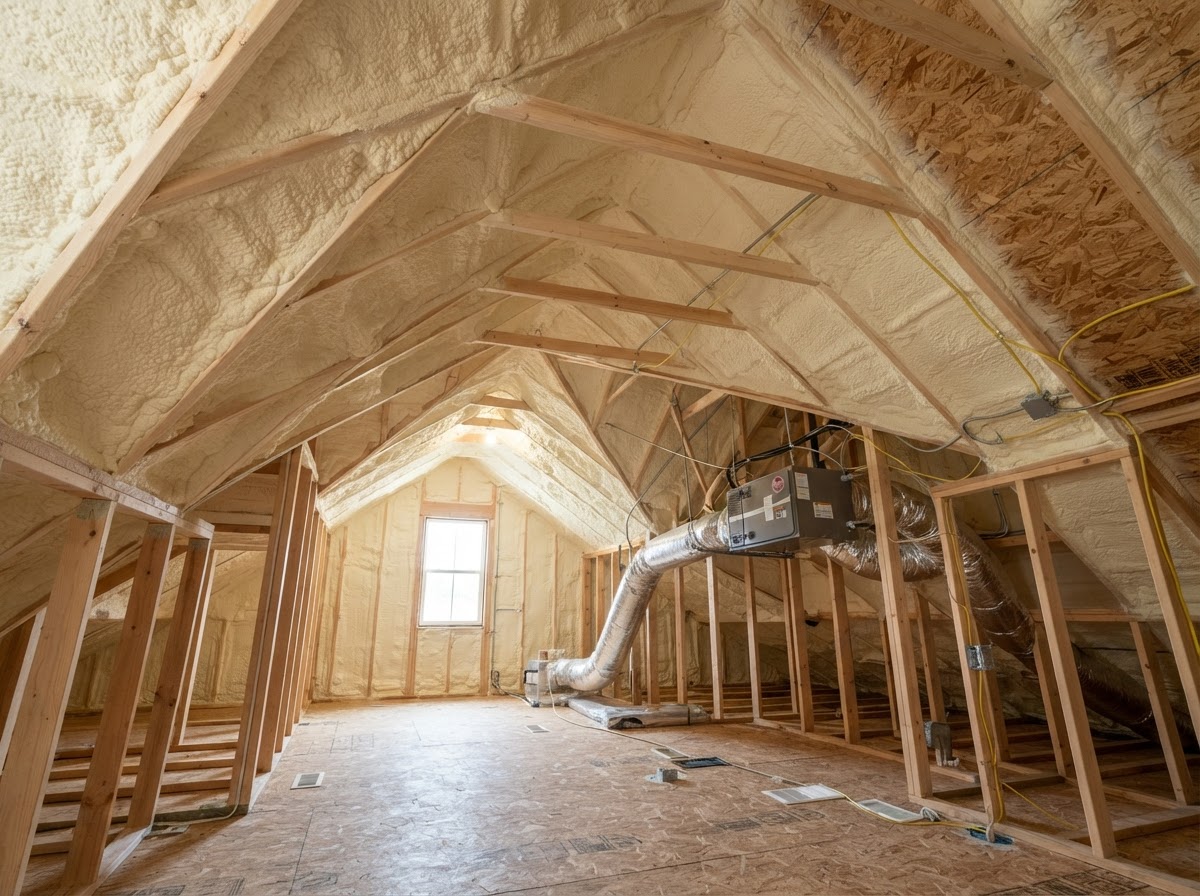
Open Cell Spray Foam Insulation in San Marcos, TX
High-Expansion Foam for Interior Air Sealing, Attics, Walls & Sound Dampening
Open cell spray foam insulation in San Marcos, TX is a lower-density, high-expansion polyurethane foam that fills irregular cavities and seals gaps for interior building assemblies. San Marcos Spray Foam Installation installs open-cell foam in attics, rooflines, framed interior walls, and other suitable assemblies throughout the San Marcos area and surrounding Central Texas communities. Open-cell foam expands substantially to conform to framing, which helps reduce uncontrolled air movement through the envelope. The right thickness and application depend on the assembly, product, and project goals. Request an open-cell spray foam estimate to discuss your project.
How Open Cell Spray Foam Works Near San Marcos
Open-cell spray foam is a lower-density polyurethane foam in which the cell walls are intentionally left open, creating a soft, flexible, high-expansion material. When sprayed, it expands many times its initial volume to fill cavities, conform to framing, and seal gaps, cracks, and penetrations in a single layer. This expansion is what makes open-cell foam effective at filling irregular spaces that are difficult to seal with rigid or batt insulation.
Where open-cell foam is commonly used: interior framed wall cavities, attic rooflines, roof decks, rim joists, and other interior assemblies where its air-sealing and sound-dampening characteristics are an advantage. It is typically considered for interior applications where vapor permeability is acceptable and the full cavity depth is available for expansion.
How open-cell differs from closed-cell: open-cell is lower density and higher expansion, and it is more vapor permeable than closed-cell foam. Closed-cell is denser, offers higher thermal resistance per inch, and has lower vapor permeance. The choice between them depends on the assembly, moisture strategy, available cavity depth, and performance goals—neither is universally better.
High Expansion
Expands many times its volume to fill irregular cavities and framing.
Air Sealing
Conforms to framing and penetrations to reduce uncontrolled air movement.
Sound Dampening
Soft, flexible structure helps dampen sound transfer between spaces.
Open Cell Foam Benefits & Application Considerations
What is open cell spray foam?
Open-cell spray foam is a lower-density polyurethane foam with open cell walls that expands many times its initial volume when sprayed, filling cavities, conforming to framing, and sealing gaps. It is typically used in interior assemblies such as attics, rooflines, and framed walls where its air-sealing and sound-dampening characteristics and vapor permeability are appropriate.
Air sealing is open-cell foam's primary strength. Its high expansion fills irregular cavities, framing transitions, and gaps around wiring and penetrations that are difficult to seal with batt insulation. This helps reduce uncontrolled air movement through the building envelope when the foam is installed as part of an appropriate envelope strategy.
Application suitability depends on the assembly and moisture strategy. Because open-cell foam is vapor permeable, it is typically used in interior assemblies where vapor permeability is acceptable—such as attics, rooflines, and interior framed walls. Assemblies where vapor control or limited cavity depth is a concern may be better suited to closed-cell foam. We recommend foam type based on the specific assembly.
Product-specific performance means exact R-value per inch varies by product and manufacturer, so we do not state a single universal R-value. The installed thickness required depends on the assembly, the product, and the project's performance goals. We scope thickness and product together during the project consultation.
Interior Air Sealing
Fills irregular cavities and framing transitions in interior assemblies.
Vapor Permeable
Typically used where vapor permeability is acceptable in the assembly.
Product-Dependent R-Value
Exact thermal performance varies by product, manufacturer, and installed thickness.
Open Cell Spray Foam Installation Process
Open-cell foam installation follows a structured process adapted to the target assembly. We do not provide DIY chemical application instructions; spray foam involves professional proportioning equipment, product-specific conditions, ventilation, and re-entry procedures that must be followed.
Jobsite preparation, ventilation, protective equipment, curing conditions, and re-entry procedures should follow the specific product requirements and project plan.
- 01
Project Consultation
We review your assembly, access, and goals to confirm open-cell foam is the right choice and scope the project.
- 02
Assembly Evaluation
We inspect cavity depth, framing, existing conditions, and moisture strategy to plan the application.
- 03
Preparation & Protection
Adjacent surfaces and contents are masked; jobsite ventilation is established for the product.
- 04
Open-Cell Application
Open-cell foam is sprayed and allowed to expand to fill the cavity at the specified thickness.
- 05
Coverage & Trim
Expanded foam is checked for full cavity fill and trimmed flush where finishes will follow.
- 06
Cleanup & Re-Entry Guidance
We clean the site and provide ventilation and re-entry guidance specific to the product used.
Open Cell Foam for San Marcos & Central Texas Properties
San Marcos Spray Foam Installation installs open-cell foam for property owners across San Marcos, Hays County, and the surrounding Central Texas communities. Open-cell foam is a common choice for residential attics, rooflines, and interior walls throughout the region, where its air-sealing and sound-dampening characteristics suit many interior assemblies.
Whether you are insulating an attic roofline, interior framed walls, or a roof deck, the right approach depends on the assembly, moisture strategy, and available cavity depth. We help property owners weigh open-cell versus closed-cell foam and plan thickness for the specific application.
Related foam-type and assembly services:
Considering Open Cell Spray Foam in San Marcos, TX?
Talk with San Marcos Spray Foam Installation about your attic, roofline, or interior walls. We help you determine whether open-cell foam is the right choice and plan the right thickness for your assembly.
Open Cell Spray Foam FAQs for San Marcos Property Owners
What is open cell spray foam?
Open-cell spray foam is a lower-density polyurethane foam with open cell walls that expands many times its initial volume when sprayed, filling cavities, conforming to framing, and sealing gaps. It is typically used in interior assemblies such as attics, rooflines, and framed walls where its air-sealing and sound-dampening characteristics and vapor permeability are appropriate.
Where is open cell foam commonly used?
Open-cell foam is commonly used in interior framed wall cavities, attic rooflines, roof decks, and rim joists—interior assemblies where its high expansion, air sealing, and sound dampening are an advantage and where vapor permeability is acceptable in the assembly.
Is open cell foam suitable for attics?
Yes. Open-cell foam is a common attic application, particularly at the roofline, where it can bring the attic inside the conditioned envelope. Its high expansion fills irregular framing and seals gaps. Existing insulation and ventilation are evaluated before installation, and the moisture strategy is planned for the assembly.
Is open cell foam appropriate for exterior walls?
It can be, depending on the assembly and moisture strategy. Open-cell foam is vapor permeable, so its use in exterior wall assemblies depends on the wall design, climate, and vapor-control approach. Closed-cell foam may be preferred where vapor permeance is a concern. We recommend foam type based on the specific wall assembly.
How does open cell compare with closed cell foam?
Open-cell is lower density, higher expansion, and more vapor permeable; closed-cell is denser, offers higher thermal resistance per inch, and has lower vapor permeance. Neither is universally better. The choice depends on the assembly, moisture strategy, available cavity depth, and performance goals.
How thick does open cell foam need to be?
Required thickness depends on the assembly, the specific product, the project's performance goals, and applicable requirements. Because open-cell foam expands substantially, it is typically installed to fill the available cavity depth. We scope thickness and product together during the project consultation rather than stating a single universal number.
Considering Open Cell Spray Foam in San Marcos, TX?
Talk with San Marcos Spray Foam Installation about your attic, roofline, or interior walls. We help you determine whether open-cell foam is the right choice and plan the right thickness for your assembly.