
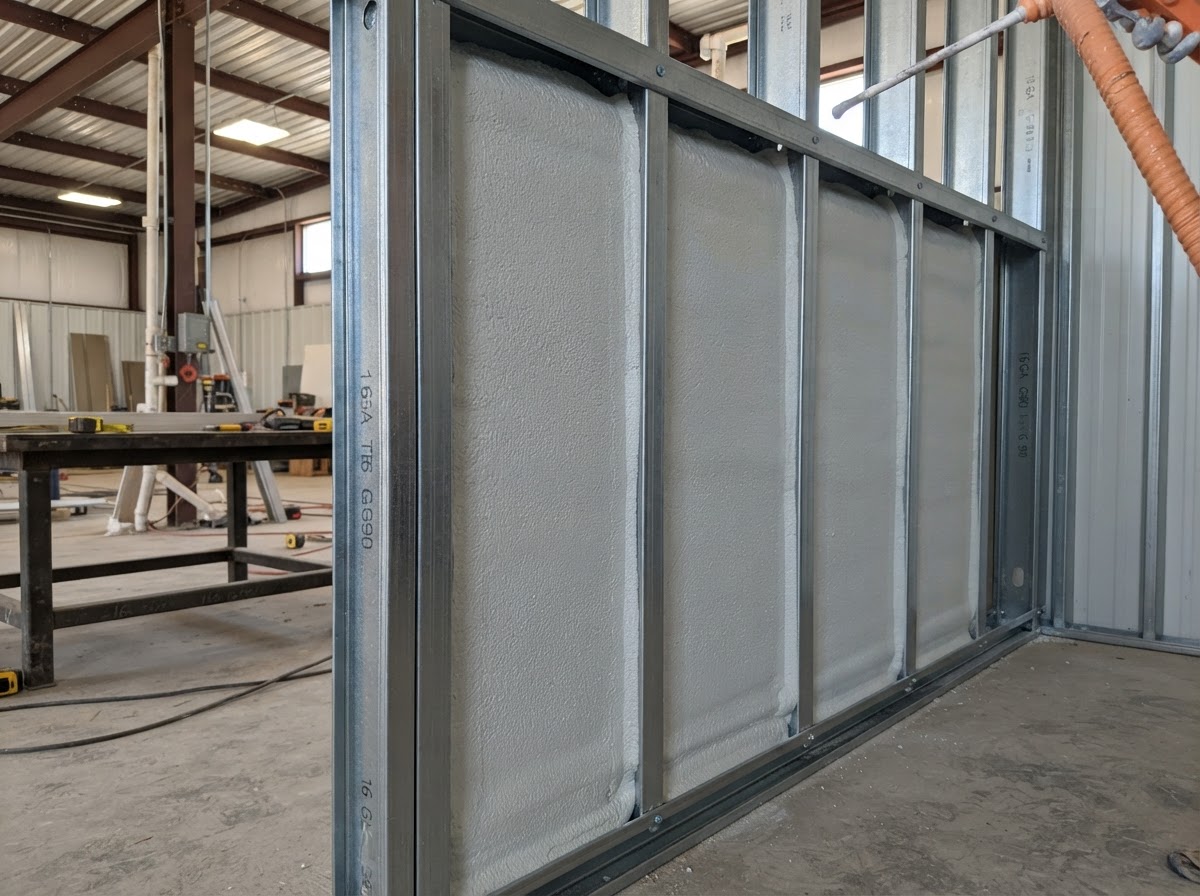
Closed Cell Spray Foam Insulation in San Marcos, TX
Dense, High-Performance Foam for Metal Buildings, Walls, Roofs & Condensation Strategy
Closed cell spray foam insulation in San Marcos, TX is a dense, rigid polyurethane foam offering higher thermal resistance per inch and lower vapor permeance than open-cell foam. San Marcos Spray Foam Installation installs closed-cell foam in metal buildings, exterior wall assemblies, roof applications, and space-constrained assemblies throughout the San Marcos area and surrounding Central Texas communities. Closed-cell foam's density, rigidity, and vapor characteristics make it a frequent choice for metal structures and assemblies where limited cavity depth or condensation strategy is a concern. Request a closed-cell spray foam estimate to discuss your assembly.
Closed Cell Spray Foam for San Marcos Properties & Assemblies
Closed-cell spray foam is a higher-density polyurethane foam in which the cell walls are closed, creating a dense, rigid material that cures to a hard, structural-feeling layer. It expands less than open-cell foam but offers higher thermal resistance per inch in many products and lower vapor permeance—characteristics that make it suited to space-constrained assemblies and applications where vapor control is a consideration.
Where closed-cell foam is commonly used: metal buildings and steel structures, exterior wall assemblies, roof applications, and assemblies where limited cavity depth makes higher per-inch performance relevant. Its density and rigidity also add structural reinforcement to the assembly, and its low vapor permeance is a factor in condensation-strategy planning for metal substrates.
Why property owners search for closed-cell foam specifically: metal buildings, shallow framing, condensation concerns, and assemblies where open-cell foam's vapor permeability may not be appropriate. Closed-cell is not universally better than open-cell—the right choice depends on the assembly, moisture strategy, cavity depth, and performance goals—but it is frequently the better fit for metal and space-constrained applications.
Metal & Steel Buildings
Dense foam adhering to metal panels for thermal and condensation strategy.
Exterior Wall Assemblies
Higher per-inch performance for space-constrained wall cavities.
Roof Applications
Rigid foam for roof decks and assemblies where density is relevant.
Closed Cell Foam Performance & Vapor Considerations
What is closed cell spray foam?
Closed-cell spray foam is a higher-density polyurethane foam with closed cell walls that cures to a dense, rigid layer offering higher thermal resistance per inch and lower vapor permeance than open-cell foam. It is commonly used in metal buildings, exterior wall assemblies, roof applications, and space-constrained assemblies where its density and vapor characteristics are relevant.
Higher thermal resistance per inch makes closed-cell foam relevant where cavity depth is limited. In many products, closed-cell foam offers greater thermal resistance per inch than open-cell foam, which matters in shallow framing or where the assembly limits available depth. Exact R-value per inch varies by product and manufacturer, so we do not state a single universal value.
Lower vapor permeance is a key characteristic. Closed-cell foam is less vapor permeable than open-cell foam, which is a consideration in condensation-strategy planning for metal buildings and assemblies where vapor control matters. However, closed-cell foam is not a universal vapor barrier under every condition—permeance depends on the product and installed thickness, and condensation control depends on the whole building-envelope and moisture-management strategy.
Closed-cell foam is not waterproof in the sense of eliminating all moisture from every structure. It helps manage condensation and vapor movement as part of an appropriate assembly, but it does not prevent all condensation under every condition. We qualify building-science claims appropriately and plan the product and thickness around the specific assembly and moisture strategy.
Higher R-Value Per Inch
Greater thermal resistance per inch suits shallow or limited-depth assemblies.
Lower Vapor Permeance
A consideration in condensation-strategy planning for metal and exterior assemblies.
Rigid Structure
Dense, rigid cured layer adds structural reinforcement to the assembly.
Closed Cell Spray Foam Installation Process
Closed-cell foam installation follows a structured process adapted to the target assembly. We do not provide DIY chemical application instructions; spray foam involves professional proportioning equipment, product-specific conditions, ventilation, and re-entry procedures that must be followed.
Jobsite preparation, ventilation, protective equipment, curing conditions, and re-entry procedures should follow the specific product requirements and project plan.
- 01
Project Consultation
We review your assembly, substrate, and goals to confirm closed-cell foam is the right choice and scope the project.
- 02
Assembly & Substrate Evaluation
We inspect cavity depth, substrate condition, moisture strategy, and access to plan the application.
- 03
Preparation & Protection
Substrates are cleaned as needed; surfaces and contents are masked; jobsite ventilation is established.
- 04
Closed-Cell Application
Closed-cell foam is applied in lifts at the specified thickness using proportioning equipment.
- 05
Coverage & Thickness Review
Applied depth is verified against the specification; foam is trimmed where finishes follow.
- 06
Cleanup & Re-Entry Guidance
We clean the site and provide ventilation and re-entry guidance specific to the product used.
Closed Cell Foam Across San Marcos & Central Texas
San Marcos Spray Foam Installation installs closed-cell foam for property owners across San Marcos, Hays County, and the surrounding Central Texas communities. Closed-cell foam is a frequent choice for metal buildings, steel structures, and exterior wall assemblies throughout the region, where its density, vapor characteristics, and per-inch performance suit many demanding assemblies.
Whether you are insulating a metal shop, exterior walls, or a roof deck, the right approach depends on the assembly, substrate, moisture strategy, and available cavity depth. We help property owners weigh closed-cell versus open-cell foam and plan the product and thickness for the specific application.
Related closed-cell and assembly services:
Considering Closed Cell Spray Foam in San Marcos, TX?
Talk with San Marcos Spray Foam Installation about your metal building, exterior walls, or roof assembly. We help you determine whether closed-cell foam is the right choice and plan the right thickness for your assembly.
Closed Cell Spray Foam FAQs for San Marcos Property Owners
What is closed cell spray foam?
Closed-cell spray foam is a higher-density polyurethane foam with closed cell walls that cures to a dense, rigid layer offering higher thermal resistance per inch and lower vapor permeance than open-cell foam. It is commonly used in metal buildings, exterior wall assemblies, roof applications, and space-constrained assemblies.
Where is closed cell foam commonly used?
Closed-cell foam is commonly used in metal buildings and steel structures, exterior wall assemblies, roof applications, and assemblies where limited cavity depth or condensation strategy makes its density and low vapor permeance relevant. It is also used where structural rigidity is a benefit.
Why is closed cell foam considered for metal buildings?
Closed-cell foam adheres directly to metal panels, offers higher thermal resistance per inch in shallow profiles, has lower vapor permeance (a factor in condensation strategy), and adds rigidity. These characteristics suit the shallow framing and metal substrates common in pre-engineered steel buildings.
Does closed cell foam provide more R-value per inch?
In many products, yes. Closed-cell foam typically offers higher thermal resistance per inch than open-cell foam, which matters where cavity depth is limited. Exact R-value per inch varies by product and manufacturer, so we do not state a single universal value and scope product and thickness together.
Is closed cell foam waterproof?
Closed-cell foam is not waterproof in the sense of eliminating all moisture from every structure. It has lower vapor permeance than open-cell foam and helps manage condensation and vapor movement as part of an appropriate assembly, but it does not prevent all condensation under every condition. Permeance depends on product and thickness.
How does closed cell compare with open cell foam?
Closed-cell is denser, offers higher thermal resistance per inch, and has lower vapor permeance; open-cell is lower density, higher expansion, and more vapor permeable. Neither is universally better. The choice depends on the assembly, moisture strategy, available cavity depth, and performance goals.
How is closed cell foam pricing determined?
Pricing depends on the application area, installed thickness, substrate preparation, accessibility, and overall project scope. Closed-cell foam typically requires a higher investment than open-cell due to material density. Request a project-specific estimate for accurate closed-cell pricing.
Considering Closed Cell Spray Foam in San Marcos, TX?
Talk with San Marcos Spray Foam Installation about your metal building, exterior walls, or roof assembly. We help you determine whether closed-cell foam is the right choice and plan the right thickness for your assembly.