
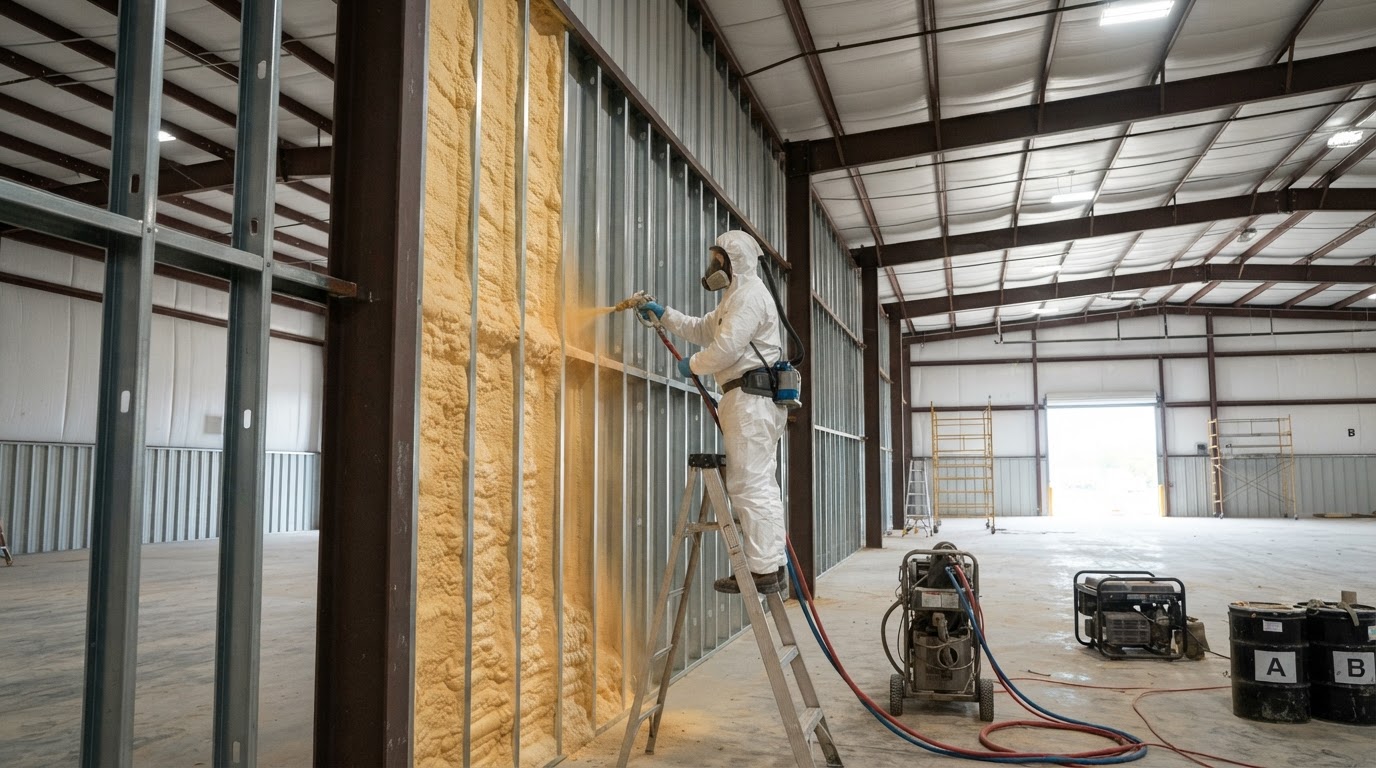
Spray Foam Insulation in Austin, TX
Residential & Commercial Foam for New Construction, Retrofits, Attics, Wall Assemblies, Garages, Workshops, Metal Structures & Building-Envelope Performance
Spray foam insulation in Austin, TX supports residential, commercial, new construction, existing-home retrofits, attics, wall assemblies, garages, workshops, and metal structures across the greater Austin metropolitan area. San Marcos Spray Foam Installation serves Austin-area spray foam projects from its Central Texas service base in San Marcos, installing both open-cell and closed-cell polyurethane foam. Austin's broad market means a wide range of building-envelope projects, from custom-home rooflines to commercial buildouts. The right foam type, thickness, and assembly strategy depend on your building design and performance goals—request an Austin spray foam estimate to discuss the specifics.
Spray Foam Options for Austin Homes and Commercial Buildings
Spray foam insulation is a polyurethane system applied as a liquid that expands and cures in place, filling cavities, gaps, and penetrations to create a continuous layer of thermal resistance and air sealing. Because foam conforms to the substrate rather than sitting loosely in a cavity, it helps reduce uncontrolled air movement through the building envelope in ways fibrous insulation alone often cannot.
Austin's property mix spans residential, commercial, new construction, existing-home retrofits, attics, wall assemblies, garages, workshops, and metal structures. New construction with open framing is ideal for planned cavity fill and roof-deck applications, while existing homes present retrofit opportunities in accessible attics and rooflines. Commercial and larger building-envelope projects often point toward closed-cell foam for density, higher thermal resistance per inch, and lower vapor permeance.
Where foam is installed and which type is selected depend on the assembly. An attic roofline may suit open-cell foam for high-expansion air sealing, while a commercial wall assembly may point toward closed-cell foam for density, vapor control, and adhesion. No single product is correct for every Austin property; the recommendation follows the building design, ventilation strategy, moisture conditions, and intended use.
Residential & Commercial
Foam for homes, commercial buildings, and larger envelope projects across Austin.
New Construction & Retrofits
Planned cavity fill for new builds plus attic and roofline retrofits.
Building-Envelope Performance
Air sealing and thermal continuity across walls, attics, and rooflines.
Austin Home Spray Foam Insulation Options
Residential spray foam in Austin covers homes, new construction, existing-home retrofits, attics, roof decks, walls, and garages. Newly framed homes can receive cavity-fill foam in exterior walls and roof-deck applications that bring the attic inside the conditioned envelope. Existing homes can be retrofitted in accessible attics and rooflines, and during remodels where wall cavities are exposed and reachable.
Attic and wall applications are a frequent focus for Austin homeowners. Foam at the roof deck can help reduce heat transfer through the roofline and bring HVAC equipment and ductwork into a semi-conditioned space. Wall assemblies in new construction can receive cavity-fill foam that seals draft pathways around framing, wiring, and penetrations. Before converting a vented attic to an unvented conditioned attic, the existing insulation and ventilation strategy must be evaluated—simply sealing vents without assembly planning is not advisable, and HVAC combustion and building design must be considered.
Garages and workshops on Austin properties are common targets when owners want a more usable space. Foam on garage and workshop walls and ceilings can help moderate interior surface temperatures, though the space will not maintain a fixed temperature without its own conditioning strategy. For homes under construction, coordinating foam with the framing, electrical, plumbing, and drywall schedule keeps the envelope plan integrated.
New Construction & Retrofits
Cavity fill, roof-deck foam, and attic retrofits coordinated with the project.
Attics & Wall Assemblies
Roof-deck and wall-cavity foam evaluated against ventilation and HVAC strategy.
Garages & Workshops
Wall and roofline foam for garages and workshops used as workspaces.
Commercial, Metal Structures & Building-Envelope Spray Foam in Austin
Austin-area properties include commercial buildings, metal structures, garages, and workshops. Closed-cell spray foam is frequently considered for commercial and metal-structure assemblies because it adheres directly to metal panels, offers higher thermal resistance per inch in many products, and has lower vapor permeance than open-cell foam—characteristics that can help manage interior surface temperatures and condensation as part of an appropriate building-envelope and moisture-management strategy.
Commercial structures in the Austin area may benefit from coordinated envelope foam across wall and roof areas. Scheduling, access, substrate conditions, and occupancy factor into how a commercial project is phased. Closed-cell foam is often considered for commercial assemblies because of its density, higher thermal resistance per inch in many products, and lower vapor permeance.
Larger building-envelope projects in Austin may combine roofline, wall, and specialty applications. The insulation plan follows the building design, ventilation strategy, and intended use. Spray foam does not prevent all condensation under every condition, and results depend on the building design, ventilation, and how the foam integrates into the overall envelope strategy.
Commercial Buildings
Coordinated envelope foam phased around access, substrate, and occupancy.
Metal Structures
Closed-cell foam adhered to metal panels for thermal and condensation strategy.
Larger Envelope Projects
Combined roofline, wall, and specialty foam for building-envelope performance.
Open Cell and Closed Cell Foam Options in Austin
Which spray foam is better for an Austin property?
The right foam depends on the building assembly, application area, available cavity depth, moisture strategy, intended use, and project goals. Open-cell and closed-cell foam serve different assemblies; neither is universally better.
Open-cell foam is lower density and expands substantially, which makes it useful for filling irregular interior cavities and providing air-sealing characteristics in suitable interior assemblies such as attic rooflines and framed walls. Its lower density means more thickness is typically required to reach a given thermal target, and it has higher vapor permeance than closed-cell foam.
Closed-cell foam is denser, offers higher thermal resistance per inch in many products, and has lower vapor permeance. Its rigid cured structure and lower permeance make it a common consideration for commercial buildings, metal structures, space-constrained cavities, and assemblies where vapor control matters. Exact thermal resistance varies by product, manufacturer, formulation, and installed thickness.
For Austin properties, the selection follows the assembly. A residential attic roofline may suit open-cell foam; a commercial or metal-structure wall may point toward closed-cell. The comparison below summarizes general differences; product-specific performance should be confirmed for the materials planned for your project.
| Feature | Open Cell | Closed Cell |
|---|---|---|
| Density | Lower density | Higher density |
| Expansion | Expands substantially | Moderate expansion |
| Typical Application Considerations | Home attics, rooflines, framed walls | Commercial, metal structures, vapor-control assemblies |
| Space / Thickness Considerations | More thickness typically needed | Higher resistance per inch in many products |
| Moisture / Vapor Characteristics | Higher vapor permeance | Lower vapor permeance |
| Project Selection | Driven by assembly and goals | Driven by assembly and goals |
How Spray Foam Is Installed Near Austin, TX
Each spray foam project follows a structured process adapted to the building and product. Spray foam installation involves professional equipment, product-specific conditions, ventilation, and re-entry procedures—this is contractor work, not a DIY chemical application guide.
Project Discussion
Review the Austin property type, use, access, and performance goals.
Application Evaluation
Assess the assembly, existing insulation, substrate, and ventilation strategy.
Foam and Assembly Planning
Select open-cell or closed-cell foam, thickness, and application area.
Work-Area Preparation
Protect adjacent surfaces and confirm substrate conditions.
Professional Application
Apply foam with appropriate equipment, PPE, and product-specific conditions.
Coverage Review
Review thickness and coverage against the planned scope.
Cleanup
Remove protection and leave the work area in order.
Re-Entry Guidance
Provide project-specific ventilation and re-entry guidance per product requirements.
Planning a spray foam project in Austin?
Discuss your property, building, attic, or construction project with our team.
Spray Foam Services Available to Austin Property Owners
San Marcos Spray Foam Installation provides the full range of core spray foam services to Austin-area properties. Explore the service pages below, and view nearby service-area resources for surrounding communities.
Nearby Service Areas
Before & After Spray Foam Insulation Transformations Near Austin, TX
These interactive before-and-after comparisons illustrate common spray foam insulation transformations for Austin properties, from modern residential construction and remodels to finished or semi-finished attics, new construction, commercial spaces, garages, tight-access roof decks, and wall systems. Each slider represents one of the thirteen primary San Marcos Spray Foam Installation services, showing how an uninsulated or under-insulated assembly changes once open-cell or closed-cell polyurethane foam is professionally applied. Austin's energy-conscious building envelopes and remodel activity make attic and roof-deck applications, wall-system insulation, and retrofit work frequent considerations. Drag the handle to compare before and after, then follow the localized link to the full service page for your Austin project.
Interactive images are representative spray foam insulation examples intended to illustrate common attic, roof-deck, wall, residential, commercial, new-construction, metal-building, pole-barn, workshop and related insulation transformations. Actual project appearance varies by property, building assembly, foam type, substrate, access and site conditions.
Spray Foam Insulation Transformation in Austin
In Austin, professionally applied spray foam can create a more continuous insulation and air-control layer across suitable building assemblies when the foam type and installation approach match the structure. The interactive comparison illustrates how a previously uninsulated or under-insulated area can be transformed with a properly applied polyurethane foam system.
Residential Spray Foam Insulation Near Austin
Residential spray foam in Austin can be applied to suitable attic, roof-deck, wall, and other building-envelope assemblies to reduce uncontrolled air movement and improve insulation continuity. The comparison shows how an unfinished residential cavity can receive a continuous foam layer.
Commercial Spray Foam Insulation in Austin
Commercial spray foam in Austin can be used in suitable wall, ceiling, roof-deck, and metal-building assemblies where insulation continuity, air control, and project-specific thermal requirements are considered. The slider illustrates a commercial assembly before and after professional foam application.
Open Cell Spray Foam Insulation Near Austin
Open-cell spray foam near Austin expands substantially and can provide insulation and air-sealing performance in suitable interior assemblies, with project-specific design considerations determining where it should be used. The comparison shows the lighter, high-expansion texture of open-cell foam filling a framed cavity.
Closed Cell Spray Foam Insulation in Austin
Closed-cell spray foam in Austin provides a dense insulation layer and can be useful in suitable building assemblies where higher insulation value per inch, air control, and moisture-related design considerations are important. The slider illustrates the denser, more compact texture of closed-cell foam on a suitable substrate.
Attic Spray Foam Insulation Near Austin
Attic spray foam near Austin can create a more continuous insulation and air-control layer when correctly designed for the roof or attic assembly, helping reduce uncontrolled heat and air transfer. The comparison shows an attic before application and after a professional foam installation.
Roof Deck & Unvented Attic Spray Foam in Austin
Roof-deck spray foam in Austin may be used as part of an appropriately designed unvented or conditioned-attic strategy, depending on the building assembly, foam type, HVAC configuration, and applicable requirements. The slider illustrates the underside of a roof deck before and after foam application.
Wall Spray Foam Insulation Near Austin
Wall spray foam near Austin can provide insulation and air-control continuity around framing and penetrations before interior finishes are installed. The comparison shows open wall framing before application and the same wall after spray foam installation.
New Construction Spray Foam Insulation in Austin
New-construction spray foam in Austin can be coordinated while framing and building assemblies remain accessible, allowing insulation and air-sealing work to be integrated before drywall and interior finishes. The slider shows a framed new build before and after the intended foam areas are insulated.
Metal Building Spray Foam Insulation Near Austin
Spray foam near Austin can be applied to suitable metal-building walls and roof assemblies to improve insulation continuity and help control uncontrolled air movement when the system is designed for the building. The comparison shows a metal building interior before and after professional foam application.
Pole Barn Spray Foam Insulation in Austin
Pole barn spray foam in Austin can be used in suitable post-frame assemblies where property owners want improved insulation continuity and reduced uncontrolled air movement. The slider illustrates a pole barn before application and after foam is applied to the wall or roof panels.
Workshop Spray Foam Insulation Near Austin
Workshop spray foam near Austin can improve insulation continuity across suitable walls and roof assemblies and may help make the space easier to condition when combined with an appropriately designed HVAC and ventilation strategy. The comparison shows a workshop before and after foam installation.
Barndominium Spray Foam Insulation in Austin
Barndominium spray foam in Austin can be applied to the roofline and wall assembly of a metal-shell barndo to help seal the envelope and reduce uncontrolled air movement. The slider illustrates a barndominium interior before and after professional foam application.
Start Your Spray Foam Insulation Project in Austin
Austin property owners can help us prepare an accurate estimate by sharing a project address or general location, the residential or commercial building type, the area requiring insulation, existing insulation condition, the attic/roof/wall/metal-building configuration, approximate square footage where known, photos of the project area, new-construction or retrofit status, and a preferred timeline.
Nearby Service Areas
Spray Foam Insulation FAQs for Austin, TX Property Owners
What types of properties can use spray foam insulation in Austin, TX?
Is spray foam suitable for attics in Austin?
What is the difference between open-cell and closed-cell spray foam?
Can an existing Austin home be retrofitted with spray foam?
Can spray foam be used in commercial buildings near Austin?
Is closed-cell spray foam useful for metal structures near Austin?
How much does spray foam insulation cost in Austin, TX?
How long does a spray foam project take?
When can occupants return after spray foam installation?
How do I request a spray foam estimate in Austin?
Need Spray Foam Insulation in Austin, TX?
Contact San Marcos Spray Foam Installation to discuss your Austin home, commercial building, new construction, retrofit, attic, wall assembly, garage, workshop, or metal structure project. We serve Austin-area properties from our San Marcos, TX 78666 base.
Or submit your details here